 Robot Linear track
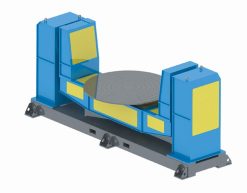 Robot welding Positioner
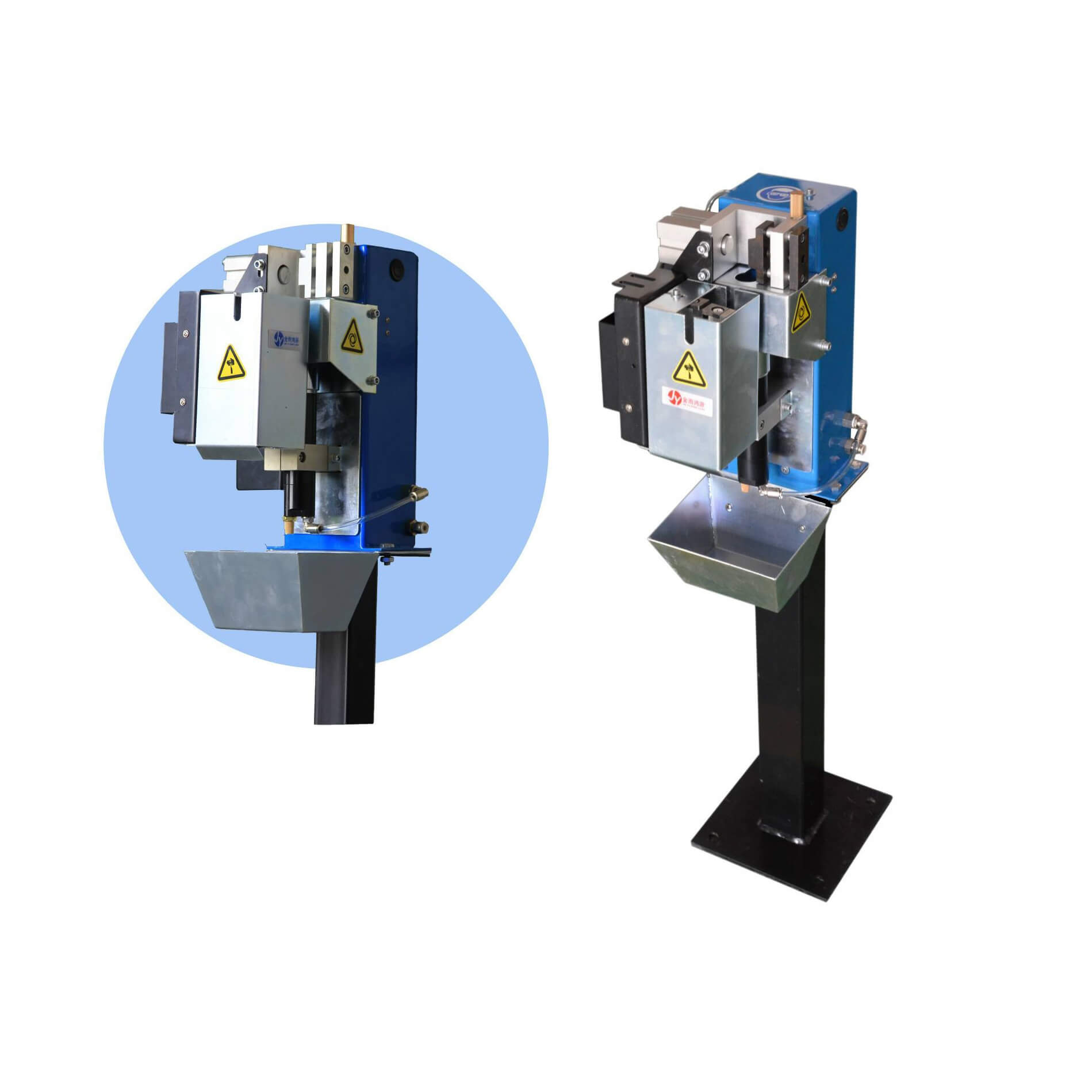 Robot Torch cleaning station
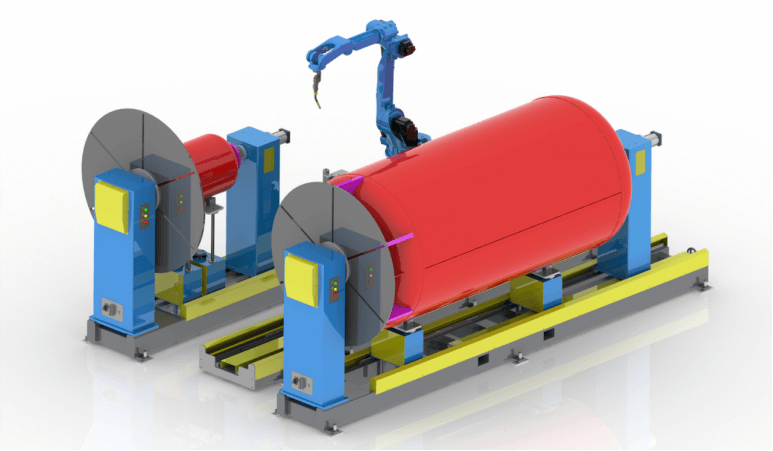 Welding Robot Workstations & Automation Solutions
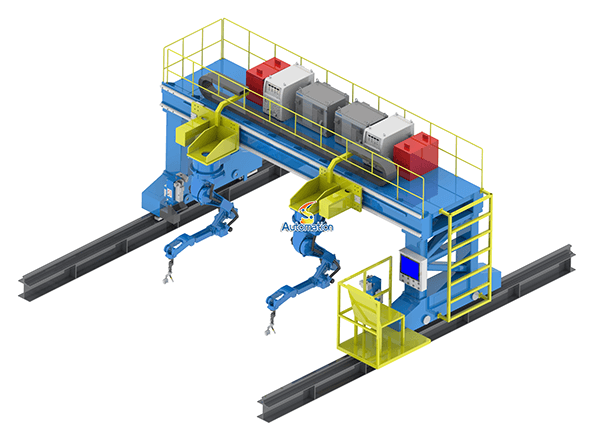 Robot Gantry System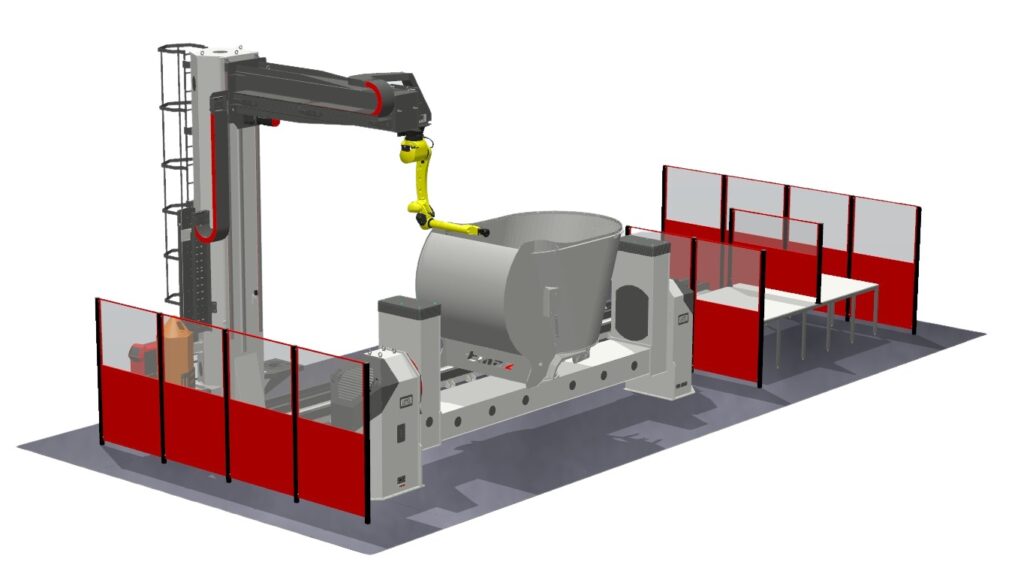
Robot Welding System with 7th Axis | WRS Robotics
Introduction
A modern robot welding system is no longer just an industrial robot mounted beside a welding fixture.
For many manufacturers, the biggest challenge is not the welding robot itself. The real difficulty is how to make the robot reach more welding positions, handle larger workpieces, reduce repositioning time, and maintain stable welding performance throughout the production cycle.
This is where a 7th axis robot track can make a significant difference.
By mounting a six-axis welding robot on a motorized linear track, the robot can travel along the production line and reach multiple welding areas from different positions. Combined with a welding positioner, the system can coordinate robot movement with workpiece rotation to create a more flexible and efficient robotic welding cell.
WRS Robotics manufactures robotic welding positioners, 7th-axis robot tracks, linear tracks and robot gantry systems for industrial automation applications. Our motion systems are designed to integrate with major industrial robot brands including ABB, FANUC, KUKA and Yaskawa.
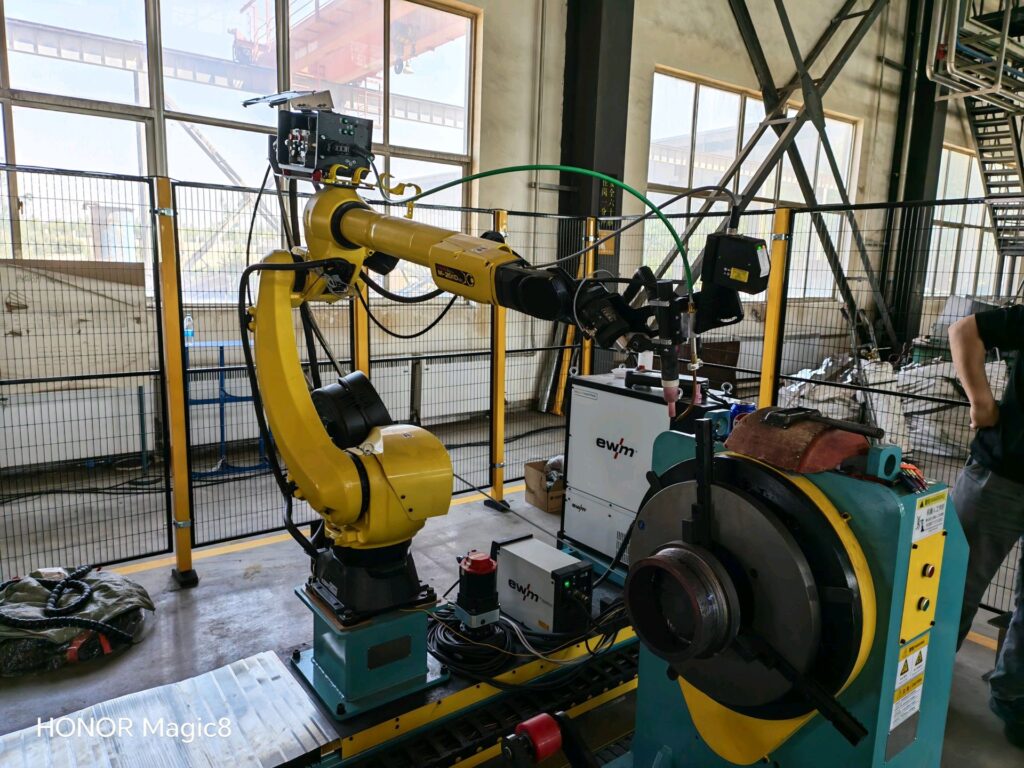
What Is a 7th Axis in a Robot Welding System?
A conventional industrial welding robot normally has six axes.
These six robot joints provide the movement required to position and orient the welding torch. However, a six-axis robot has a limited working envelope. When the workpiece is large, long, or positioned across multiple welding stations, the robot may not be able to reach every required welding point from one fixed location.
A 7th axis adds another controlled movement to the system.
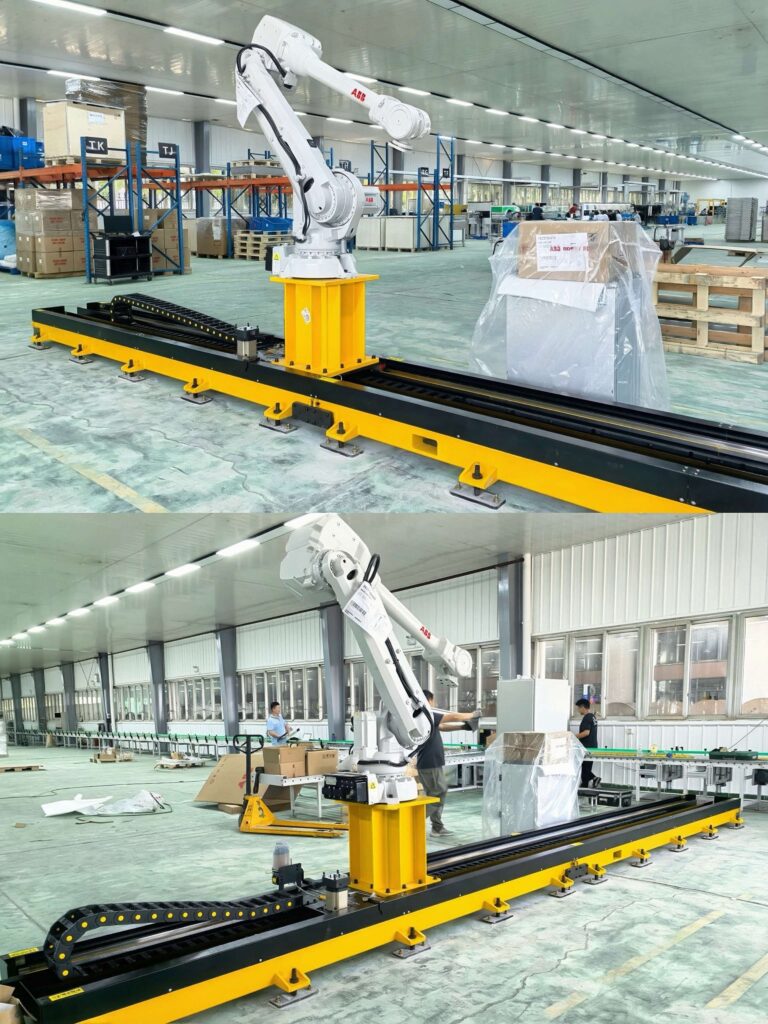
In a typical welding application, the robot is installed on a linear robot track. The track moves the complete robot along a predefined horizontal path.
Instead of:
Robot → Fixed Position → Limited Working Area
the system becomes:
Robot + 7th Axis → Multiple Working Positions → Extended Working Envelope
This additional axis is especially useful for long workpieces such as:
- Steel frames
- Construction machinery components
- Excavator buckets
- Truck chassis
- Agricultural machinery
- Structural steel components
- Large fabricated assemblies
- Long pipes and welded structures
The exact track length, payload and travel speed should be selected according to the robot model, workpiece size, welding process and required cycle time.
Why Add a 7th Axis to a Welding Robot?
1. Extend the Robot’s Working Range
The most obvious advantage is increased reach.
A welding robot mounted on a floor-mounted linear track can move along the workpiece instead of staying in one fixed position.
For long products, this can eliminate the need to use multiple robots simply because one robot cannot reach the entire workpiece.
For example, a robot with a suitable 7th-axis track can move from one end of a steel frame to another while maintaining an appropriate welding position.
This approach can make better use of an existing robot.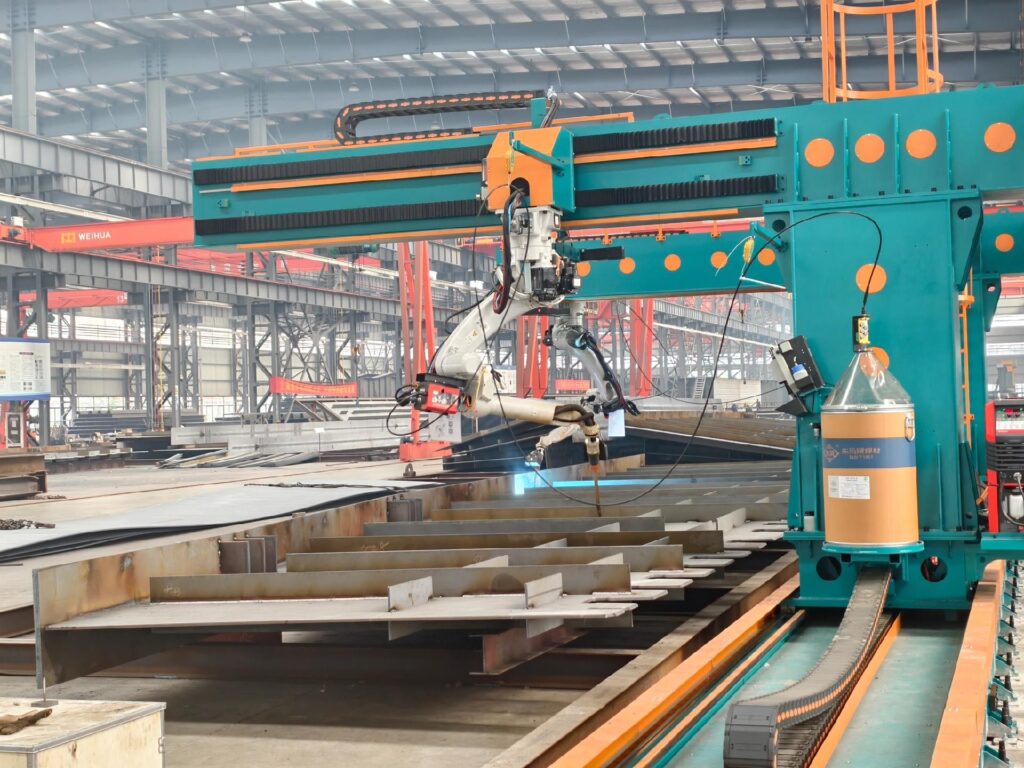
2. Reduce Robot Repositioning Problems
In a fixed robot cell, operators may need to reposition the workpiece several times to bring different welding areas into the robot’s working range.
Every additional repositioning step can increase handling time and introduce variation into the production process.
With a linear track, the robot itself can move to the required working position.
The result can be a simpler production sequence:
Load → Position → Robot Moves → Weld → Move to Next Position → Weld
This is particularly useful for large welded structures.
3. Improve Access to Complex Welding Areas
A welding robot does not only need to reach the weld.
It needs to reach the weld from an appropriate angle.
Torch accessibility is often one of the most important factors in robotic welding.
A weld may technically be within the robot’s reach but still be difficult to access because of:
- Workpiece geometry
- Fixtures
- Adjacent components
- Torch angle
- Cable interference
- Robot singularity
- Limited wrist rotation
A 7th-axis track provides another degree of freedom for positioning the robot relative to the workpiece.
This can give the robot programmer more options when planning welding paths.
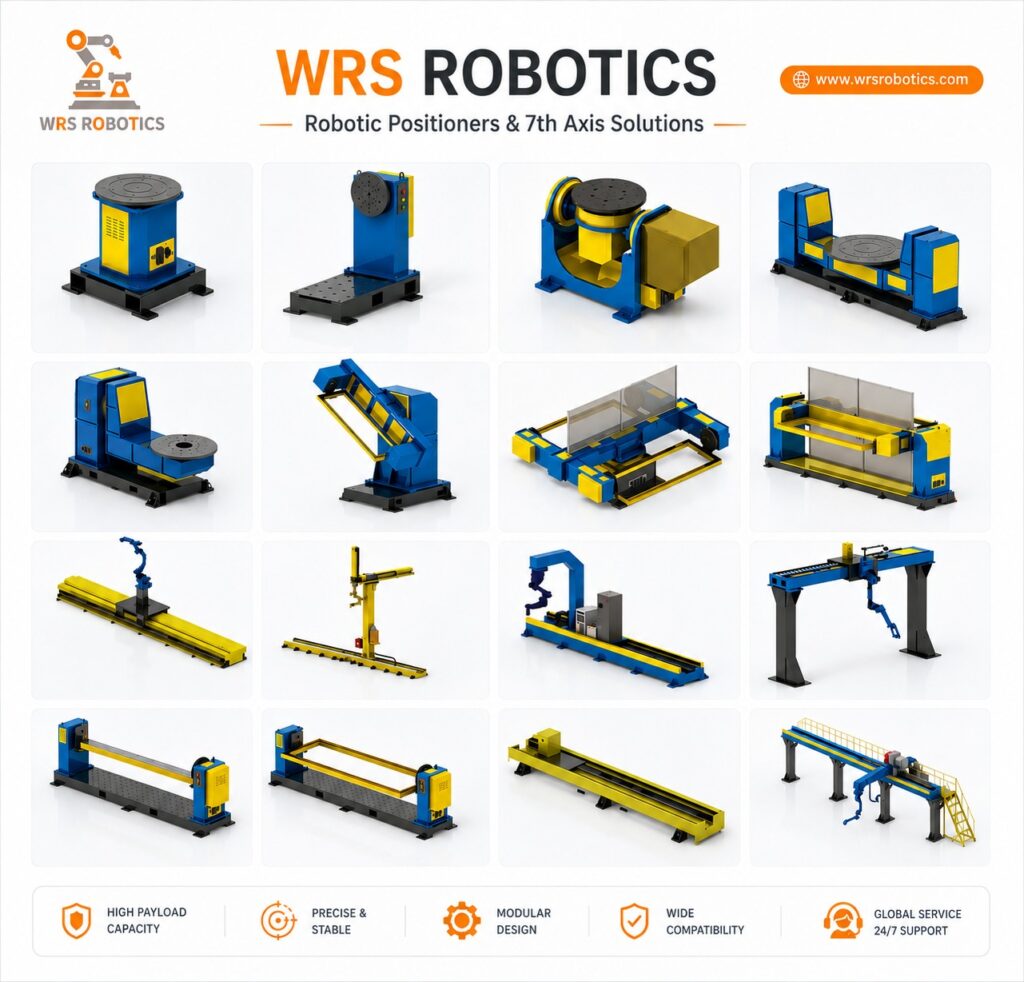
WRS Robotics 7th Axis for Robotic Welding
WRS Robotics focuses on robotic peripheral equipment designed for industrial automation.
Our robot 7th-axis systems can be configured according to the robot model, application requirements and installation environment.
Typical configurations include:
- Floor-mounted linear robot tracks
- Single-axis robot tracks
- Cantilever robot tracks
- Long-travel robot tracks
- Customized 7th-axis systems
- Robot gantry systems for larger applications
The track can be engineered around the customer’s required travel distance, robot payload, installation layout and production process.
For a welding application, the track is normally integrated with the robot controller and safety system so that robot movement and track movement work together as one robotic system.
7th Axis + Welding Positioner: A More Flexible Combination
A linear track extends the robot’s movement.
A welding positioner controls the workpiece.
Combining both can create a much more capable welding cell.
For example:
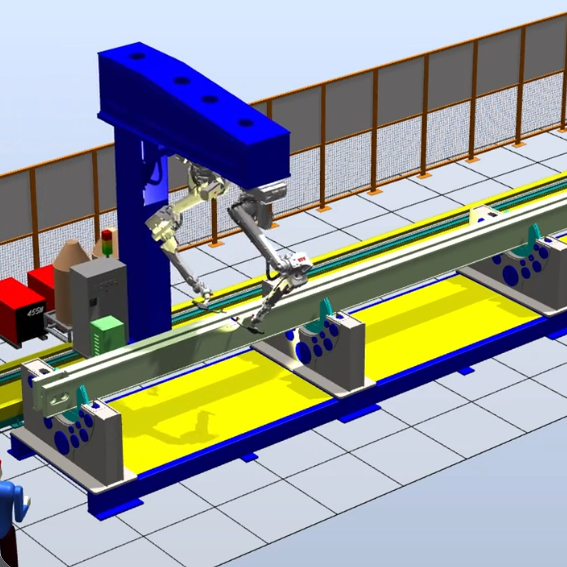
Robot + 7th Axis + 2-Axis Welding Positioner
The robot can move horizontally along the track while the positioner rotates or tilts the workpiece.
This allows the welding system to control two important variables:
Robot Position + Workpiece Position
Instead of forcing the robot to weld every joint from difficult angles, the positioner can rotate the workpiece into a more suitable welding position.
This can help improve:
- Torch accessibility
- Welding position
- Cycle consistency
- Robot utilization
- Production flexibility
- Welding quality
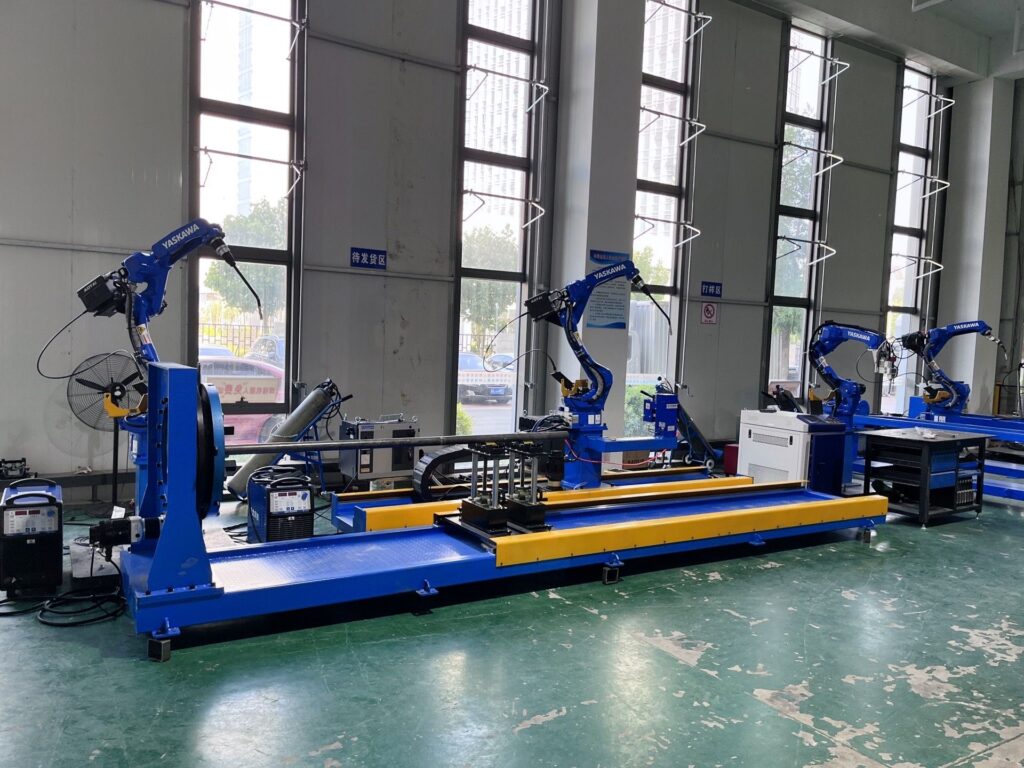
WRS Robotics supplies different types of robotic welding positioners, including single-axis, two-axis, L-type and customized positioner solutions.
How a Typical Robot Welding System Works
A typical WRS Robotics welding system may include the following equipment:
1. Industrial Welding Robot
The robot performs the welding operation.
Depending on the project, the system may use an ABB, FANUC, KUKA, Yaskawa or other compatible industrial robot.
The robot selection depends on:
- Payload
- Reach
- Welding torch weight
- Required positioning accuracy
- Workpiece dimensions
- Production cycle
- Welding process
2. 7th Axis Robot Track
The robot is installed on a moving carriage.
The track provides the additional linear axis required to move the robot along the workpiece.
Important track specifications include:
- Total travel length
- Maximum payload
- Travel speed
- Positioning accuracy
- Rail structure
- Drive system
- Installation method
- Robot mounting configuration
The correct track specification should always be calculated based on the actual robot and application rather than selecting a track based only on travel length.
3. Welding Positioner
The positioner rotates or tilts the workpiece.
Depending on the application, WRS Robotics can provide:
- Single-axis positioners
- Two-axis positioners
- L-type positioners
- Headstock-tailstock positioners
- Rotary tables
- Customized welding positioners
For large or irregular components, the positioner can be designed according to the workpiece weight, dimensions, center of gravity and required rotation range.
4. Welding Power Source
The welding power source is selected according to the required welding process.
Common processes include:
- MIG
- MAG
- TIG
- Pulse MIG/MAG
- Other industrial welding processes
The welding power source needs to communicate correctly with the robot controller and welding system.
5. Robot Controller and Motion Coordination
The robot controller manages the robot axes and welding sequence.
For a 7th-axis system, the external axis needs to be properly integrated into the robot control architecture.
The controller must coordinate:
Robot Axes + 7th Axis + Positioner + Welding Equipment
This is one of the most important engineering aspects of the entire system.
Simply placing a robot on a linear rail does not automatically create a functional 7-axis welding system.
The mechanical design, electrical control, robot programming and safety system must all work together.
Key Factors When Selecting a Robot Linear Track
Choosing the correct robot linear track requires more than deciding how long the rail should be.
1. Robot Payload
The track carriage must support the complete moving load.
This may include:
- Robot
- Robot base
- Dress package
- Cable management
- Additional tooling
- Other accessories
The dynamic load should be considered rather than only the static weight.
2. Travel Length
The required travel length depends on the workpiece and the robot’s effective working envelope.
A common mistake is selecting a track that is simply the same length as the workpiece.
The actual calculation should consider:
Robot Reach + Track Travel + Robot Installation Position + Welding Access
A longer track is not necessarily a better solution if it is not required by the application.
3. Track Speed
Track speed affects the production cycle.
However, maximum speed is not the only consideration.
Acceleration, deceleration and positioning performance can also influence the welding process.
The track should provide stable movement and accurate positioning rather than simply achieving a high travel speed.
4. Installation Environment
The track may be installed:
- Directly on the factory floor
- On a steel structure
- On an elevated platform
- Overhead
- As part of a gantry system
The foundation and installation conditions should be considered during the initial design.
Floor-Mounted 7th Axis vs. Robot Gantry System
Not every large welding application requires a conventional floor-mounted linear track.
For very large components or special factory layouts, a robot gantry system may be more appropriate.
Floor-Mounted Robot Track
Best suited for:
- Medium and large welding cells
- Long workpieces
- Floor-level production
- Standard robotic welding applications
Overhead or Gantry Robot System
Best suited for:
- Very large workpieces
- Large working envelopes
- Multiple workstations
- Heavy industrial structures
- Applications requiring overhead robot movement
The best solution depends on the workpiece and factory layout.
WRS Robotics can design both robot linear track systems and modular gantry systems for different industrial robot applications.
Common Problems Customers Face When Adding a 7th Axis
Problem 1: The Robot Cannot Reach the Entire Workpiece
This is one of the most common reasons for adding a linear track.
A 7th axis allows the robot to travel along the workpiece and access multiple welding areas.
Problem 2: Too Many Robot Repositioning Operations
If operators have to repeatedly move the workpiece, productivity can suffer.
A robot track can reduce unnecessary handling by allowing the robot to move instead.
Problem 3: Poor Torch Accessibility
Even when the robot can technically reach a weld, the welding torch may approach from an unsuitable direction.
Combining a 7th axis with a welding positioner can provide additional positioning flexibility.
Problem 4: Cable Management
Long-travel robot tracks require proper cable management.
Robot cables, welding cables, communication cables and other lines need to move safely with the robot.
An appropriate cable carrier and routing system should be included during the engineering stage.
Poor cable management can result in:
- Cable wear
- Unexpected downtime
- Interference
- Maintenance problems
For this reason, cable routing should not be treated as an afterthought.
Robot Welding System Safety
Safety needs to be considered from the beginning of the project.
The latest ISO 10218-1:2025 covers safety requirements for industrial robots, while ISO 10218-2:2025 addresses industrial robot applications and robot cells, including integration and commissioning.
A complete robotic welding cell may require appropriate:
- Safety fencing
- Safety doors
- Emergency stops
- Safety scanners or light curtains
- Interlocks
- Safety PLC
- Robot safety functions
- Welding protection
- Smoke extraction
- Grounding and electrical protection
The exact safety design depends on the complete machine, installation environment, local regulations and application risk assessment.
For international projects, safety and compliance requirements should be discussed during the engineering stage rather than after manufacturing is completed.
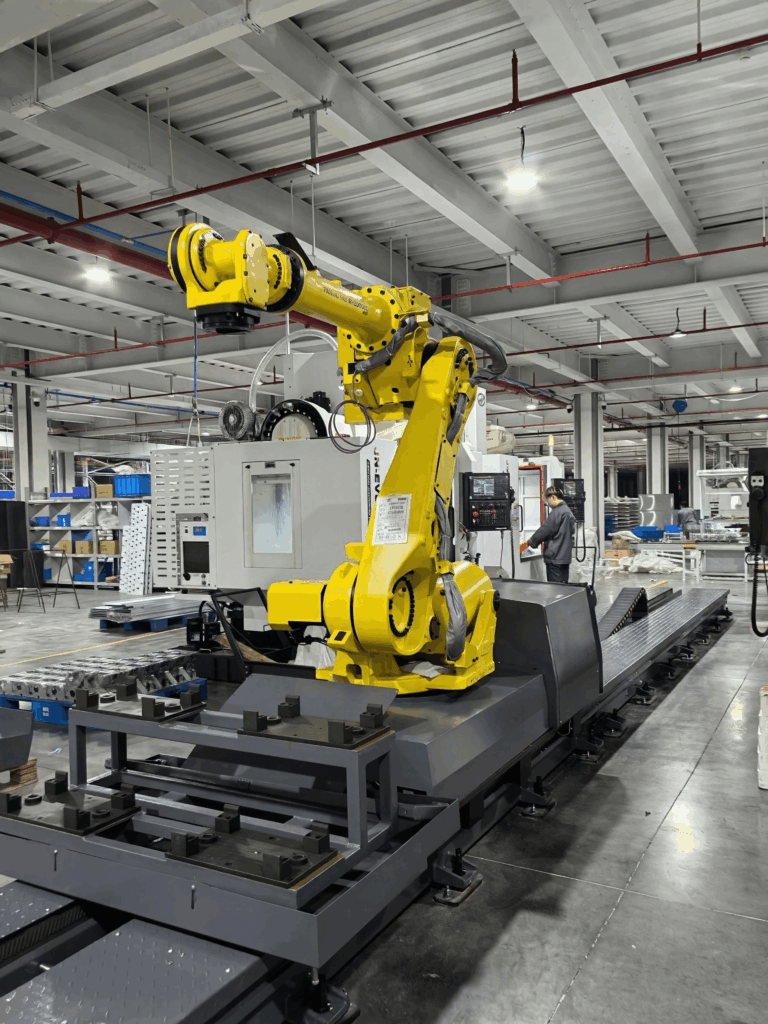
Integration with ABB, FANUC, KUKA and Yaskawa Robots
One of the advantages of using a dedicated robot peripheral manufacturer is the ability to design the mechanical system around the customer’s selected robot.
WRS Robotics’ 7th-axis systems and welding positioners can be engineered for integration with major robot brands, including:
ABB
ABB provides industrial robots and dedicated welding solutions for arc welding and other manufacturing applications.
FANUC
FANUC robots are widely used in industrial welding and manufacturing automation. When integrating a FANUC robot with a WRS Robotics linear track, the external axis configuration should be matched to the robot controller and application requirements.
KUKA
KUKA’s robotic welding solutions include welding robots, positioners and linear units, demonstrating the importance of coordinated robot and peripheral motion in welding applications.
Yaskawa
Yaskawa welding robots and motion systems can also be integrated with external positioning equipment and robot tracks according to the application requirements.
The important point is that the robot, track and positioner should be treated as one integrated system rather than three independent machines.
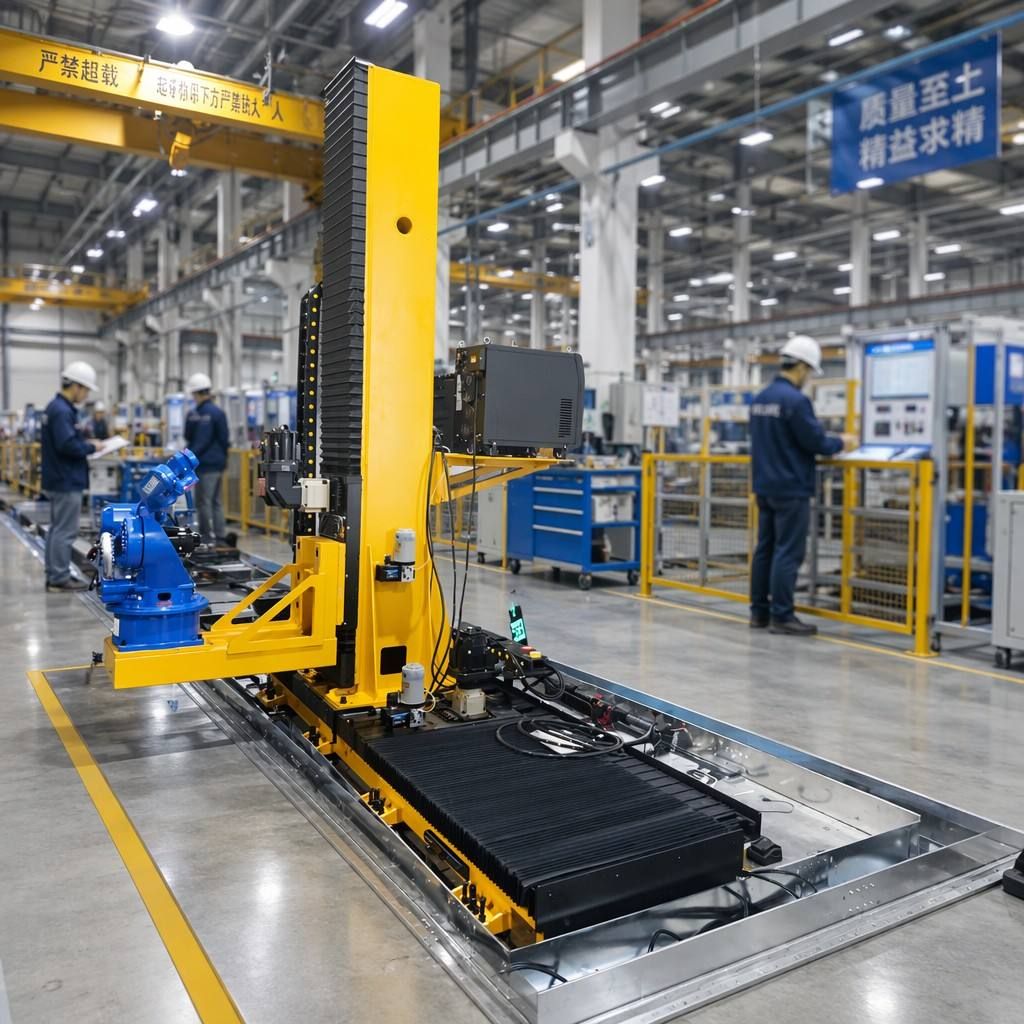
What Information Do We Need to Design a 7th-Axis Welding System?
If you are planning a robotic welding system, providing the following information can help speed up the engineering process.
Robot Information
- Robot brand
- Robot model
- Robot payload
- Robot reach
- Controller model
Workpiece Information
- Length
- Width
- Height
- Weight
- Material
- Welding joints
- Production quantity
Track Requirements
- Required travel length
- Installation method
- Robot mounting direction
- Required travel speed
- Factory floor conditions
Welding Information
- MIG/MAG/TIG or other process
- Welding power source
- Torch type
- Welding wire diameter
- Required cycle time
Positioner Information
- Workpiece weight
- Center of gravity
- Rotation range
- Required axes
- Required positioning accuracy
The more accurate the application data, the more accurately the 7th-axis system can be designed.
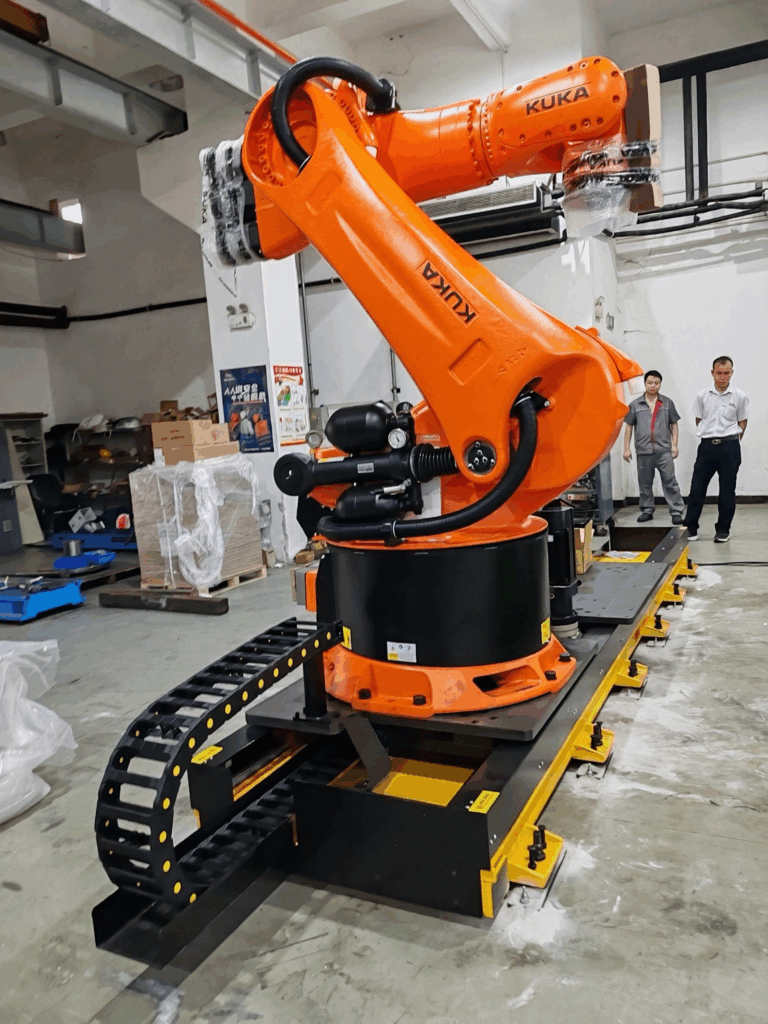
Why Choose WRS Robotics for Your Robot Welding System?
WRS Robotics focuses on the equipment that connects the robot to the production process.
Our product range includes:
Robotic Welding Positioners
Designed to rotate and position workpieces for improved welding accessibility and production efficiency.
Robot 7th Axis & Linear Tracks
Designed to extend robot working range and provide controlled linear movement.
Designed for large-scale applications requiring extended travel and high payload capacity.
Customized Robotic Peripherals
Engineered according to robot model, workpiece dimensions, factory layout and production requirements.
Rather than offering only a standard rail, WRS Robotics can work with customers to define the complete mechanical configuration around the robot and application.
A Practical Example: Long Steel Structure Welding
Consider a customer producing long welded steel structures.
The workpiece is too long for the robot to efficiently reach all welding joints from a fixed position.
A practical solution could include:
- 1 × Industrial Welding Robot
- 1 × 7th-Axis Linear Track
- 1 × Welding Positioner
- 1 × Welding Power Source
The robot moves along the linear track while the positioner rotates the workpiece.
The welding sequence can then be divided into several working zones.
Instead of manually repositioning the robot or workpiece after every section, the complete system can move through a programmed sequence.
This type of configuration is particularly useful when manufacturers need to automate large welded components without installing multiple independent welding robots.
Is a 7th Axis Worth It?
A 7th-axis robot track is not necessary for every welding application.
For a small workpiece that can be completely accessed from one robot position, a fixed robot installation may be more economical.
However, a 7th axis becomes attractive when:
- The workpiece is long
- The robot needs to serve multiple welding areas
- Robot reach is insufficient
- Workpiece repositioning takes too much time
- A larger working envelope is required
- One robot needs to cover multiple fixtures
- The customer wants to improve robot utilization
The right solution should be based on the actual production process and return on investment rather than simply adding additional axes.
Conclusion
A robot welding system with a 7th axis can provide much more than additional robot travel.
When properly designed, the combination of an industrial welding robot, linear track and welding positioner can create a flexible system capable of handling larger workpieces, improving torch accessibility and reducing unnecessary repositioning.
The key is proper system integration.
The robot, 7th axis, welding positioner, welding equipment, cable management and safety system should be engineered together from the beginning.
For manufacturers looking for robot welding automation, robotic welding positioners, 7th-axis robot tracks, linear tracks or robot gantry systems, WRS Robotics provides customized robotic peripheral solutions for industrial applications.
Need a 7th-axis solution for your welding robot?
Send us your robot model, workpiece dimensions and required track length. Our engineering team can recommend a suitable configuration for your application.
WRS Robotics
Manufacturer of Robotic Welding Positioners & 7th-Axis Robot Tracks
🌐 https://wrsrobotics.com/
📩 info@wrsrobotics.com