
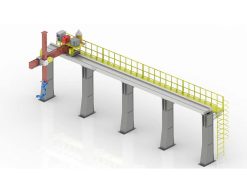
 Robot Linear track
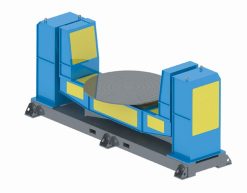 Robot welding Positioner
 Robot Torch cleaning station
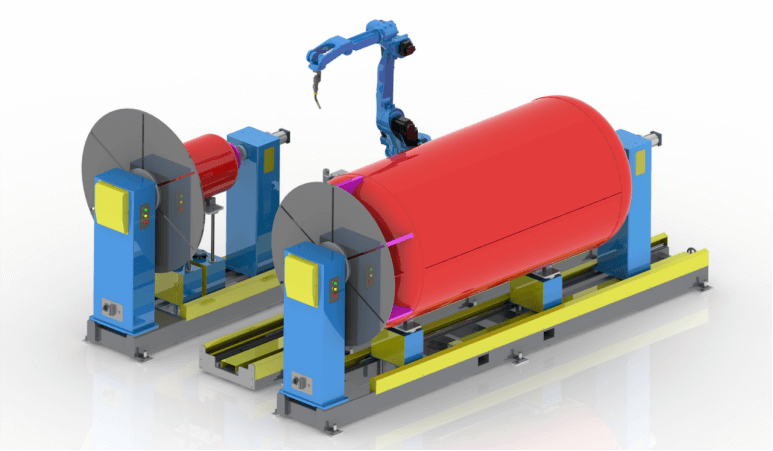 Welding Robot Workstations & Automation Solutions
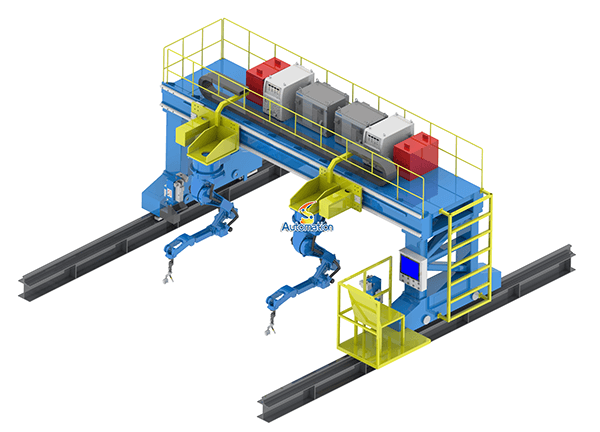 Robot Gantry System
The cell works — until the floor runs out
A fabrication shop adds a welding robot on a linear track. The cell works well. Then the orders grow. The parts get longer. The fixtures get bigger. And one day the integrator walks the floor and realises there is no room left: the track, the positioner, the fixture tables, the crane path and the forklift lane are all fighting for the same square metres.
That is usually when someone says it: “Why don’t we hang the robot from the ceiling?”
It sounds like a clean answer. The floor stays clear. The robot reaches over the part instead of alongside it. No forklift will ever hit the track. But a ceiling-mounted track is not just a floor track turned upside down. It changes the structure, the installation, the maintenance, and the cost of the whole cell. Sometimes it is the right call. Often it is not. This article compares the two the way we compare them on real projects — by floor space, cost, accuracy, maintenance, and the daily work of running the cell.
Floor-mounted: the default for a reason
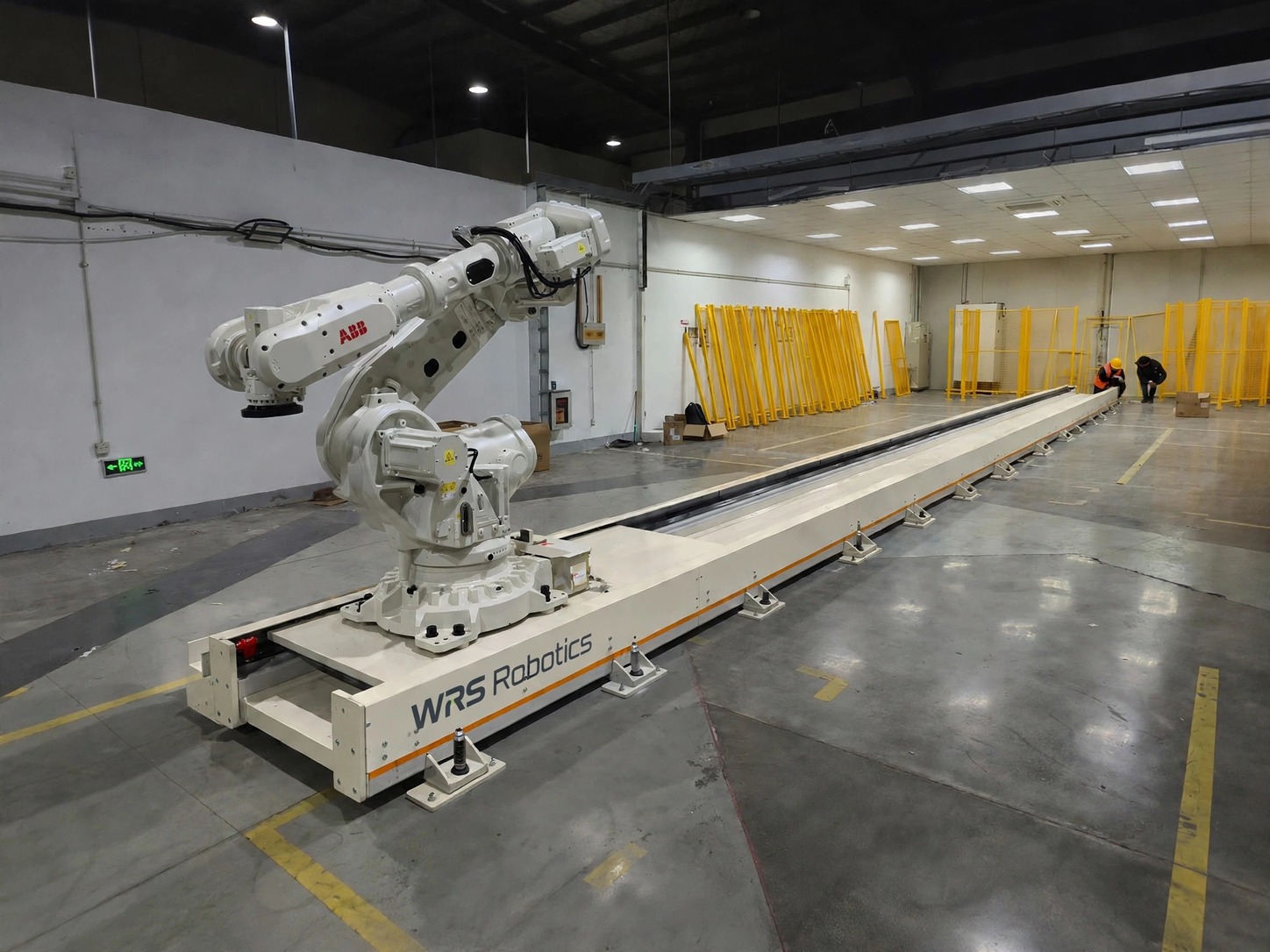
A floor-mounted track bolts to the floor, usually on a steel base or a concrete foundation. The robot stands upright on a carriage and travels along the rail. This is the layout most integrators know best, and for most cells it is the right starting point.
It is simple to install. The foundation is at ground level. Surveying, levelling and alignment all happen where a person can stand next to the work. A laser tracker, a spirit level and a torque wrench are all you need, and you can walk the full length of the track to check it.
Maintenance is simple too. The rail, the rack, the guides and the cable chain are all within reach. A technician can clean, lubricate and inspect the track from the floor, without a lift or a platform. That matters more than it sounds: the tracks that hold their accuracy longest are the ones that actually get maintained, and a track that is easy to reach gets maintained.
A floor track is also easy to extend. If the cell grows and the robot needs another two metres of travel, you add rail sections and lengthen the foundation. The robot stays upright, which is the mounting position every robot maker designs for first. Cable management is straightforward: the energy chain runs along the floor beside the track.
The weaknesses are all about space and exposure. A floor track takes floor space — not just the rail itself, but the safety zone around it. The rail sits where chips, weld spatter and grinding dust land. And it sits where forklifts drive. We have seen more tracks damaged by a forklift tyre than by any welding fault. Guards and bollards help, but they take even more space.
For most heavy fabrication cells — structural steel, construction machinery, pressure vessels — the floor-mounted track is still the default. It is cheaper to install, easier to keep accurate, and easier to live with. The question is whether your shop has the floor to spare.
Ceiling-mounted: the floor stays clear, the work moves up
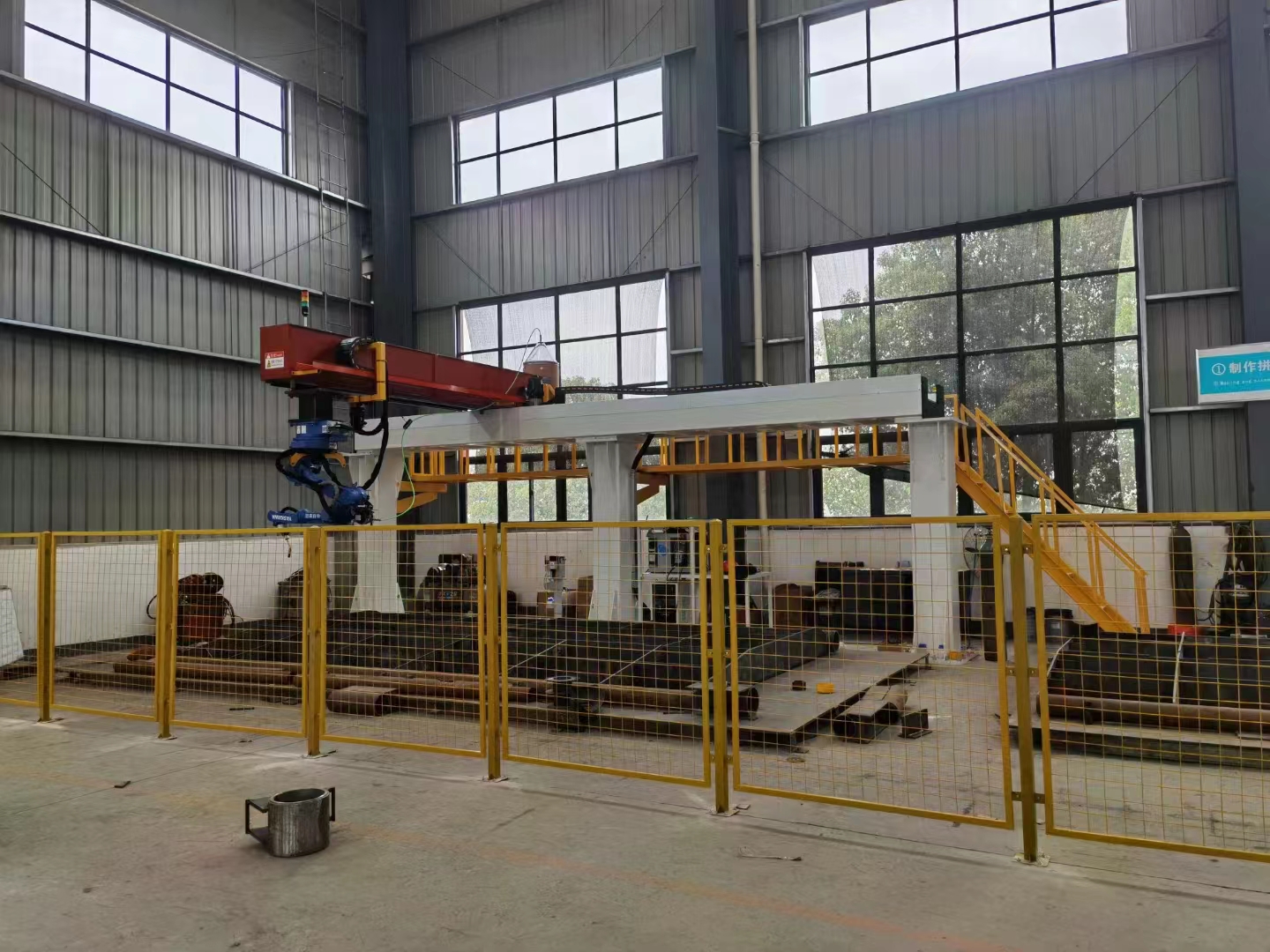
A ceiling-mounted track hangs from an overhead steel structure. The robot mounts upside down and travels along the rail above the workpiece. The floor underneath stays open for fixtures, parts, and people.
The big win is floor space. In a crowded shop, that can be the difference between automating a cell and not automating it at all. The robot reaches down onto large parts from above, which suits wide or tall workpieces that are hard to approach from the side. Loading is often easier too: a crane can lower a part straight down into the fixture without the track getting in the way. And nothing on the floor can hit the rail.
There is a real accuracy benefit that people rarely mention. On a floor track, dust and spatter settle on the rail. On an inverted rail, the running surfaces face down, so loose dust and spatter fall away from them instead of collecting on them. In a dirty welding environment, that helps. It does not remove the need for covers and cleaning, but it changes where the dirt goes.
The price for all of this is structure. A ceiling track needs something strong above it to hang from. That usually means a dedicated steel gantry frame or a reinforced part of the building structure — and that steel often costs more than the track itself. It also needs engineering: someone has to prove the structure can carry the robot, the track, and the dynamic loads while the robot moves. A building roof that looks strong is not automatically strong enough.
Maintenance moves up with the track. Lubrication, inspection and any repair now need a lift or a work platform. That means maintenance takes longer, needs more planning, and in some shops simply happens less often. A track that is hard to reach is a track that gets neglected, and a neglected track loses accuracy just like a floor track does — only harder to fix.
Installation is slower and needs lifting equipment. Every rail section, every drive unit, goes up in the air. Alignment is done from a platform, not from the floor. And the robot itself needs attention: not every robot model is rated for inverted mounting, and the ones that are may need a different mounting option, different cable routing, and a check of the wrist load ratings in the inverted position. Check the robot manual before you assume it can hang upside down.
Head to head
| Floor-mounted | Ceiling-mounted | |
|---|---|---|
| Floor space | Takes floor space plus a safety zone | Floor stays clear |
| Installed cost | Lower; foundation at ground level | Higher; overhead steel structure often costs more than the track |
| Installation | Fast, at ground level | Slower, needs lifting equipment and platforms |
| Accuracy | Very good on a proper foundation; stiffness is easy to achieve | Good, but only as stiff as the steel above it; building vibration matters |
| Maintenance | Easy, from the floor | Needs a lift or platform; takes longer |
| Environment | Rail exposed to chips, spatter, forklifts | Running surfaces face down, so dirt falls away; top of rail still collects dust |
| Loading | From the side, by forklift or crane | From above, by crane; good for very large parts |
| Robot mounting | Upright, the standard position | Inverted; check the robot is rated for it |
| Extension later | Easy, add rail sections | Harder; the overhead structure has to grow too |
| Safety | Standard fencing and guards | Add falling-object protection; nothing may come loose above people |
Neither column wins on every row. That is the whole point. The right choice depends on which rows matter most in your shop.
Accuracy is about stiffness, not height
Customers sometimes ask whether a ceiling-mounted track is less accurate than a floor-mounted one. The honest answer is that mounting height is not the deciding factor. Stiffness is.
A floor track on a well-built foundation is stiff because the ground is stiff. A ceiling track is only as stiff as the steel frame it hangs from. If that frame flexes when the robot accelerates, or picks up vibration from a crane runway or a press in the next bay, the robot will feel it at the torch. A well-designed overhead frame can be very stiff — but it has to be designed, not assumed. The same goes for temperature: a long steel structure above a welding cell moves with heat, and that movement shows up as drift if nobody accounts for it.
Our rule on every project is the same either way: check the foundation or the frame first, then the track. We covered the foundation side in our guide to robot track installation mistakes, and the drift that shows up months later in why robot tracks lose accuracy after six months — the causes are the same for both mounting styles, only the structure that moves is different.
The robot does not care — mostly
A robot on a ceiling track works upside down. For the robot, that changes a few things that are easy to miss in planning.
First, the mounting. Robot makers publish which mounting positions each model supports: floor, wall, ceiling, or angled. Some models support inverted mounting out of the box. Others need a factory option, a different counterbalance, or a software setting. If the robot you already own is not rated for inverted mounting, a ceiling track means buying a different robot — and that changes the budget completely.
Second, the wrist. Inverted, gravity pulls on the wrist and the tool in the opposite direction from normal. The payload rating still applies, but the load on specific wrist axes changes. Check the load diagram for the inverted position, not just the headline payload number. A torch, a dress pack and a heavy workpiece fixture can add up fast.
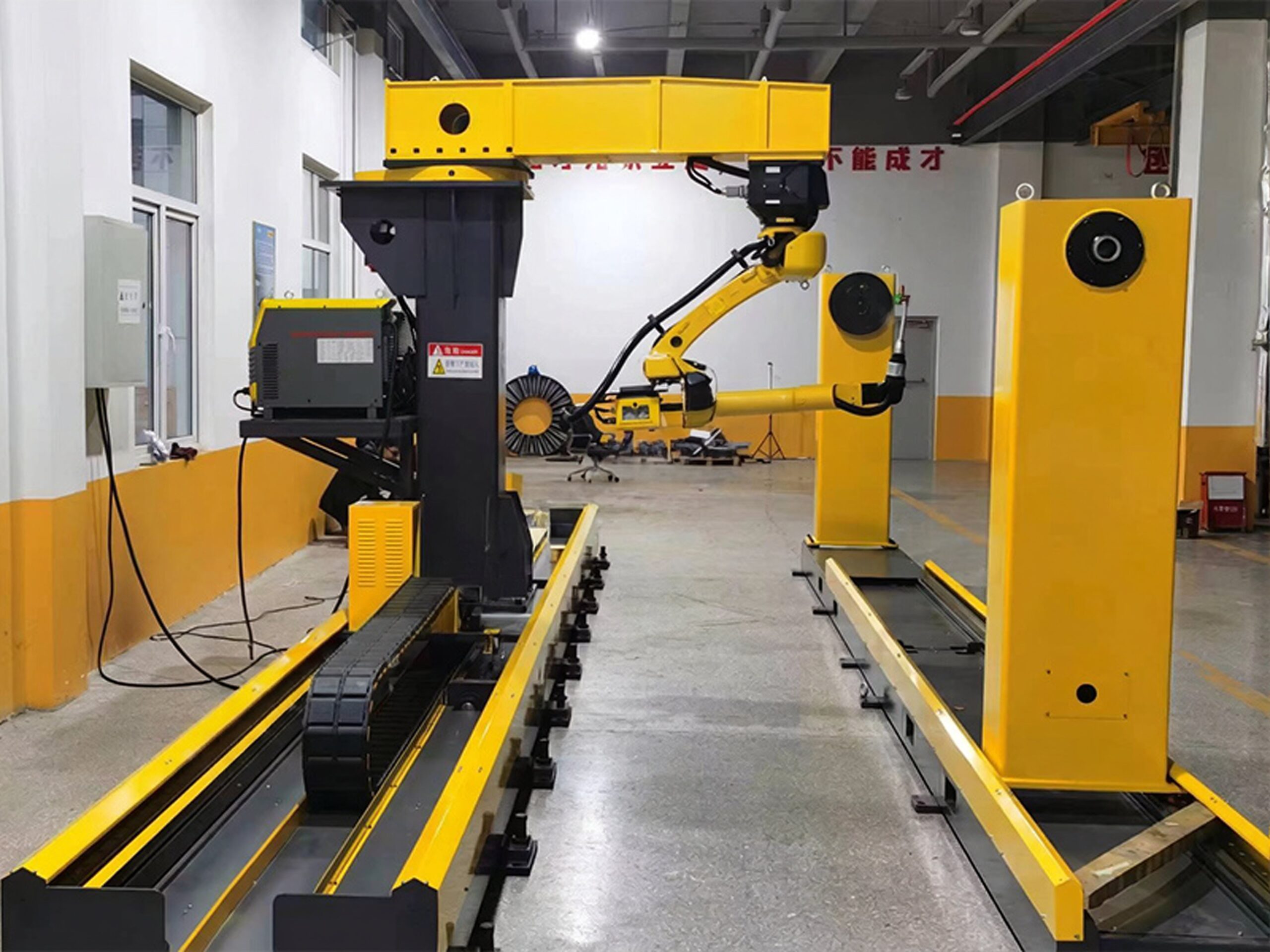
Third, cables. The robot dress pack and the track energy chain have to work upside down without sagging onto the workpiece or snagging on the fixture. This is solvable, and it is routine on gantry-style cells, but it needs to be designed in — not discovered at commissioning. Our robot linear track pages show both mounting styles, and the same cable-chain thinking applies to gantry systems too.
Finally, calibration. Mastering and calibration work the same upside down, but the reference points are harder to reach. Plan for a platform or a safe way to get to the robot during commissioning. The first calibration sets the accuracy of the whole cell, and it is not a job to rush from a ladder.
Loading and workflow decide more than the brochure does
The best way to choose is to walk the cell in your head, one part at a time.
With a floor track, the part usually arrives by forklift or crane from the side, and the fixture sits at floor level. That is familiar and flexible. The cost is floor space and a track that shares the floor with everything else in the shop.
With a ceiling track, the part usually arrives by crane from above and drops into the fixture. That suits very large parts — long beams, wide frames, tall assemblies — that are awkward to bring in from the side. The floor under the track stays free for fixtures, for a second workstation, or simply for people to walk through.
But watch for the conflict nobody puts in the brochure: the overhead structure and the crane. If the shop crane runs on the same runway the ceiling track hangs from, or if the crane hook cannot travel over the cell because the track structure is in the way, loading becomes a problem instead of a benefit. We have seen cells where the ceiling track was perfect on paper and the crane could not reach the fixture. Check the crane path before you commit.
Also think about what happens next to the cell. A floor track can grow longer, and a second positioner can be added alongside it. A ceiling track can grow too, but the steel above it has to grow with it, and that is a bigger job. If the cell will change in two years — a longer part, a second station, a bigger robot — say so now. The mounting choice that is right today can be the wrong one after the first expansion.
What it actually costs
Nobody buys a track by the catalogue price alone, and the mounting choice is where that shows up most.
A floor-mounted track costs less to install. The foundation is concrete and steel at ground level. The work is fast and uses standard equipment. Over the life of the cell, maintenance is cheap because everything is reachable.
A ceiling-mounted track usually costs more before it moves a single part. The overhead steel frame, its engineering, and its installation are a separate project — and in many quotes, that frame costs more than the track. Add the platforms or lift access for maintenance, and the gap grows. Over the years, every service visit takes longer.
That does not make the ceiling track a bad buy. Floor space has a price too. In a shop where floor space is the constraint — where the alternative is renting more space, or not automating at all — the ceiling track can be the cheaper answer overall. The mistake is comparing the two tracks against each other and forgetting the building. Compare the whole installed cell, including the structure, the crane changes, and the maintenance access, and the numbers usually decide themselves.
Five mistakes we see most often
- Choosing the ceiling to save space without checking the building. The roof or the crane runway looks strong. It often is not strong enough for a moving robot, or not stiff enough. Get a structural check before you order anything. A track that hangs from a frame that flexes will never hold accuracy, and fixing the frame afterwards costs far more than checking it first.
- Forgetting maintenance access. A ceiling track that nobody can reach does not get lubricated. Budget the platform or the lift, and put the access into the layout drawings, not just the maintenance manual. If the only way to reach the rail is to stop the whole bay and bring in a scissor lift, maintenance will keep being postponed.
- Assuming any robot can hang upside down. Check the robot’s mounting options first. Some models need a factory option for inverted mounting, and some older models do not support it at all. Finding this out after the track is ordered is an expensive surprise.
- Ignoring the crane. The ceiling track and the shop crane share the air above the cell. Make sure the crane can still reach the fixture, and that the track structure does not block the hook path. Walk the crane route on the drawing before you approve the layout.
- Comparing track prices instead of cell prices. The ceiling track itself may cost about the same as a floor track. The steel above it, the engineering, the installation time and the maintenance access are where the real difference sits. Quote the whole cell, not the track.
Decision checklist
Use this before you request a quotation. If you can answer every line, the supplier can recommend the right mounting the first time.
- Floor space available for the cell, including the safety zone and forklift lanes
- Part size and weight, and how the part arrives — forklift from the side, or crane from above
- Crane coverage: can the hook reach the fixture with the track structure in place
- Building structure: what the ceiling track would hang from, and whether it has been checked
- Robot model, and whether it is rated for inverted mounting
- Foundation for a floor track, or steel frame design for a ceiling track
- Maintenance access: how a technician reaches the rail, the rack, and the drive
- Environment: weld spatter, grinding dust, and chips — where they land on each option
- Future plans: longer parts, a second station, a bigger robot
- Whole-cell cost: track, structure, installation, crane changes, and maintenance access
If most of your answers point to floor space pressure, tall or wide parts, and crane loading from above, a ceiling track is worth pricing. If they point to a tight budget, easy maintenance, a standard robot, and room to grow along the floor, the floor track is the safer choice. And if the cell also needs a positioner, our guide to choosing the right welding positioner covers how the positioner type and the track layout work together — the two decisions are best made at the same time.
FAQ
Q1: Can any industrial robot be ceiling-mounted?
A1: No. Each robot model has published mounting positions — floor, wall, ceiling, or angled. Some models support inverted mounting as standard, some need a factory option, and some do not support it at all. Check the robot manual and the load diagram for the inverted position before planning a ceiling track. If the robot you own cannot hang upside down, a ceiling track means a different robot.
Q2: Is a ceiling-mounted robot track less accurate than a floor-mounted one?
A2: Not by itself. Accuracy depends on the stiffness of whatever the track is fixed to. A floor track on a good foundation is stiff. A ceiling track is only as stiff as the steel frame above it. A well-designed overhead frame can hold accuracy just as well — but a frame that flexes under the robot’s acceleration, or picks up vibration from a crane runway, will show up as drift at the torch. The structure decides, not the height.
Q3: Which mounting is cheaper?
A3: The floor-mounted track is almost always cheaper to buy and install. The ceiling track itself may cost a similar amount, but the overhead steel structure, its engineering, and the installation work usually cost more than the track. The exception is when floor space is the real constraint: if a ceiling track avoids renting more space or building an extension, it can be the cheaper answer for the whole project. Compare the whole cell, not the track alone.
Q4: Which is better for robotic welding?
A4: Both work well for welding. A floor track suits most welding cells: easy maintenance, standard robot mounting, and simple cable management. A ceiling track suits cells where the floor is crowded, the parts are very large, or the part must be loaded by crane from above. In dirty welding environments, the inverted rail has one advantage — dust and spatter fall away from the running surfaces instead of settling on them — but it still needs covers and regular cleaning.
Q5: Can a ceiling-mounted track be extended later?
A5: It can, but it is a bigger job than extending a floor track. The overhead steel structure has to be extended too, and the new section has to align with the old one to the same tolerance. If you think the cell will grow, tell the supplier now. It is much cheaper to design the frame for a future extension than to rebuild it later.
Q6: How much floor space does a ceiling track actually save?
A6: The rail itself is only part of it. A floor track also needs a safety zone, guards, and clearance for forklifts. A ceiling track frees all of that floor — often several square metres along the whole length of the cell. That space can hold a fixture table, a second workstation, or simply a clear walkway. Measure the whole cell footprint, not just the rail.
Q7: Do I need a special foundation for a floor-mounted robot track?
A7: Yes, in most cases. A robot track needs a level, stable base that will not settle or flex under the moving load. That usually means a concrete foundation or a steel base frame, anchored and levelled to the track maker’s tolerance. A track bolted straight to an ordinary warehouse slab without checking the slab is one of the most common installation mistakes — we covered it in our installation mistakes guide. If you are unsure about the floor, ask the supplier what the foundation needs before the track arrives.
The bottom line
Floor-mounted and ceiling-mounted tracks are not a good option and a bad option. They are two answers to different problems. A floor track is cheaper, simpler, and easier to keep accurate — and it is the right choice for most cells. A ceiling track earns its keep when floor space is the constraint, when parts are loaded by crane from above, or when the floor has to stay clear for the rest of the shop.
Choose by walking the cell, not by reading the brochure. Check the floor space, the crane path, the building structure, and the robot’s mounting options. Price the whole cell, including the steel above it and the maintenance access. Get those checks right and either mounting will serve the cell well for years.
If you are planning a cell and weighing the two options, send us the details: the part size and weight, the floor space available, the crane coverage, and the robot model. We will help you work out which mounting fits your shop — before you spend money on the wrong one. You can reach us at info@wrsrobotics.com or through the contact form on our robot linear track page.